About a month ago, my partner and I escaped to northern Tasmania for a trip that felt far too brief. We stayed in a secluded cabin, far from traffic and screens, where evenings were spent lighting fires and watching the sun dissolve behind mountain ridges. As keen birdwatchers, we were rewarded with flashes of movement in the trees — parrots and wrens illuminated in honeyed light, their calls threading through the stillness.
Returning to Sydney was jarring. Our flat sits on a busy road, wedged between vape shops and convenience stores plastered with garish, AI-generated posters. The contrast felt brutal. The quiet grandeur of Tasmania gave way to concrete and neon, and I found myself sinking into a familiar urban gloom — the sense that something fundamental about modern life had gone astray.
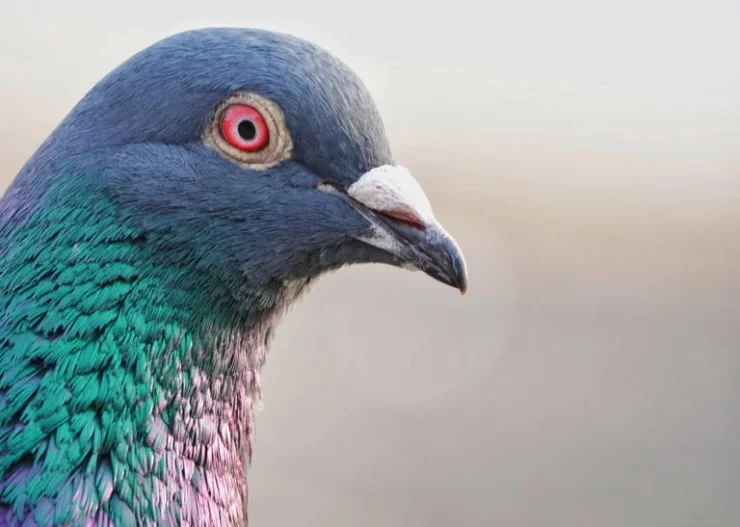
Then, one morning, I noticed a pigeon perched just above my front door. The feathers at her throat shimmered green in the light, iridescent and unexpectedly beautiful. She cooed softly as her mate arrived with a beak full of twigs, the two of them collaborating on a nest tucked into the eaves of our building.
It struck me how thoroughly we train ourselves not to notice what is ordinary. Our brains filter out the familiar, scanning instead for novelty or disruption. The everyday fades into invisibility. Pigeons, ubiquitous and unremarkable in most eyes, embody that neglect. We tend to register them only as nuisances — when they gather in numbers or leave droppings behind. Yet they are frequently mistreated, shooed away, even harmed, as though their presence were an affront.
And yet their presence is entirely our doing. Urban pigeons descend from domesticated birds once cherished for carrying messages across vast distances. We bred them, relied on them, brought them into our orbit. They remain drawn to us still, thriving in the landscapes we’ve constructed. If they root through rubbish or roost on ledges, it is because our cities provide those opportunities.
Intrigued, I began seeking them out. Days later, I passed a cluster pecking at a discarded loaf of bread, their layered coos rising and falling like water over stone. It wasn’t wilderness, but it was alive.
A late-night internet rabbit hole revealed that pigeons can distinguish between paintings by Monet and Picasso — a detail both charming and oddly profound. The image of a pigeon discerning impressionism from cubism delighted me, as did the human curiosity that prompted such research in the first place.
We love dividing the world into opposites: nature and city, human and animal, exceptional and mundane. But the ordinary is not devoid of wonder simply because it is familiar. Even in dense urban sprawl, wildlife persists. Pigeons remain, quietly building alongside us — cohabitants rather than intruders — reminding us that the natural world has not entirely retreated from our reach.