Ireland are unlikely ever to rival South Africa’s sheer physical dominance, replicate England’s conveyor belt of depth, or match the instinctive flair and athleticism of France. In the aftermath of the 2023 World Cup, there has been a noticeable recalibration in approach. The intricate, possession-heavy attacking structure that once defined Andy Farrell’s side has gradually given way to a more territory-driven, kick-oriented strategy. That tactical pivot explains why Sam Prendergast has been entrusted with the No.10 jersey and why the emphasis has shifted toward long-range kicking rather than multi-phase ball-in-hand fluency.
James Lowe’s powerful left boot has arguably become more influential than his attacking incision, while Hugo Keenan’s absence in Paris underlined how critical aerial security has become. Compare Ireland’s dynamic Grand Slam-era victory over France in 2023 with last week’s defeat in Saint-Denis: attacking metres plummeted dramatically. Although Ireland achieved parity at set-piece—where many anticipated they would struggle—the contest was ultimately decided in the loose exchanges.
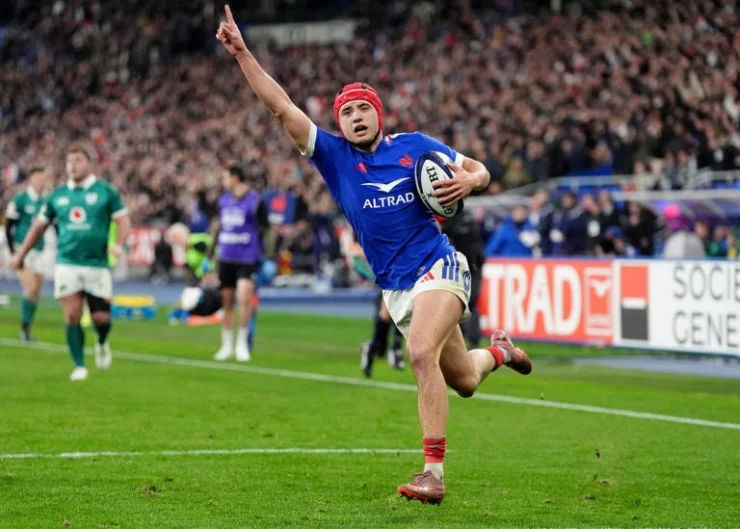
France’s second-row pairing of Charles Ollivon and Mickaël Guillard demonstrated mobility and breakdown dynamism that exposed Ireland’s limitations. Joe McCarthy appeared laboured, while Tadhg Beirne was repeatedly nullified at the breakdown. The French appetite for loose ball, combined with superior pace, was decisive—epitomised by Louis Bielle-Biarrey’s clinical finish.
Selection questions inevitably follow. Josh van der Flier’s automatic inclusion warrants scrutiny; his impact levels have dipped from the standards expected of a former World Player of the Year. A start for Nick Timoney against Italy could provide both competition and refreshment. Similarly, McCarthy’s costly offside penalty at Test level was inexcusable, and James Ryan presses strongly for reintegration. The front row may also see adjustment, with Tadhg Furlong potentially restoring stability.
However, the most pressing concerns lie behind the scrum. Ireland kicked 40 times against France, half of those contestable, yet regained only seven. France, by contrast, reclaimed nine of ten contestables. Historically, under Joe Schmidt, Ireland excelled in kick-retention because they combined elite kicking accuracy with outstanding aerial specialists. Jamison Gibson-Park is an exceptional attacking scrum-half but lacks Conor Murray’s box-kicking precision. Prendergast, still early in his international development, requires time to cultivate consistency.
Law changes have further altered aerial contests, favouring chaotic regather scenarios over structured protection. France adapted more effectively, regathering 22 of 30 contestable kicks across the match. Ireland’s injuries—particularly to Keenan and Jimmy O’Brien—have reduced their aerial edge.
The 50:22 tactic briefly unsettled France, yet Thomas Ramos and the French backfield adjusted swiftly, outmanoeuvring Ireland territorially. France embraced the confrontational aspects—line speed, breakdown pressure—that previously defined Ireland.
To recalibrate, Ireland must reintroduce the credible threat of a running game. Jack Crowley’s introduction in Paris injected variety. A configuration featuring Gibson-Park at nine, Prendergast at ten, Jacob Stockdale and Tommy O’Brien on the wings, Stuart McCloskey at inside centre, Jamie Osborne at outside centre, and Crowley operating as a secondary distributor from full-back would diversify Ireland’s attacking picture. Dual playmakers would alleviate pressure on Prendergast while preserving territorial kicking options.
Omitting Garry Ringrose is contentious, yet his defensive reads against France misfired within a system overly reliant on aggressive line shooting. Ireland lack the overwhelming tackle dominance of South Africa to sustain such a high-risk rush defence. Against elite opposition, failed defensive gambles create fatal fragmentation.
Ultimately, to defeat heavyweights like England or South Africa, Ireland must reclaim territorial control without surrendering attacking identity. Adjustments in the backline appear the logical starting point.