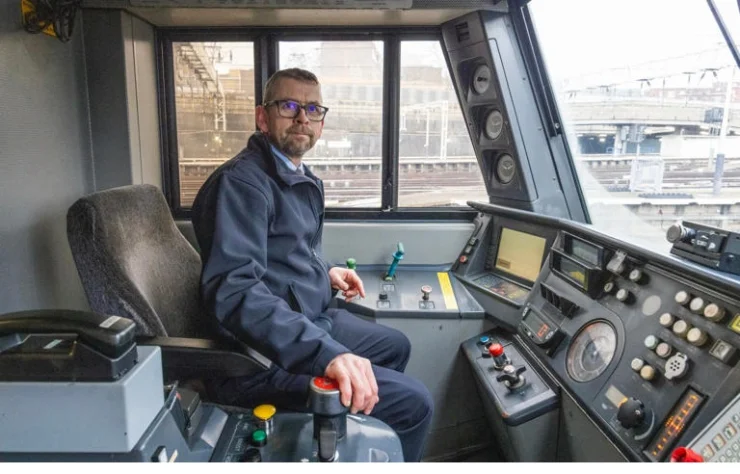
Thomas is candid that his stretch of the Caledonian Sleeper’s “Highlander” route is not the most dramatic on the network. It lacks the sweeping scenery of the northern drives over the Cumbrian Fells, but the rhythm of the journey has its own appeal. He departs London Euston at 9.15pm, hands over to another driver in Preston just after midnight, and then swaps again at around 3am with a southbound “Lowlander” driver to take him home. By 7.30am, he is back at Euston, the night’s work complete while much of the city is just waking up.
His route follows the West Coast Main Line through Rugby, Stafford and Lancashire, though engineering works sometimes divert him to the East Coast. Unlike most drivers, who rarely vary their routes, Thomas appreciates this flexibility. “We’re lucky that way,” he says.
Thomas earns £79,000 a year, slightly above the national average of £76,327 for train drivers, according to the Office for National Statistics. With his wife also working full-time, he feels financially secure raising their two sons in South London. “You can pay your mortgage. It’s a safe place to be,” he says, “but we’re not going to retire to the Bahamas.” He reflects on older colleagues who spent decades on lower pay in exchange for the promise of a generous final salary pension, a guarantee largely unavailable to new starters today, who are typically on defined contribution schemes.
Train drivers are now among Britain’s best-paid professionals, alongside pilots and head teachers. In 2024, Labour agreed to a 15 per cent pay rise after prolonged strikes, a settlement estimated to cost taxpayers £135 million. Public support had waned by that point, with polling showing a majority opposed to further strikes. Thomas feels drivers are often misunderstood. “People think you’d go sick at the drop of a hat,” he says, “but there’s a real pride in keeping things moving.” Whether salaries seem high, he argues, depends on whether the role is seen as a specialist profession with heavyresponsibility.
Entry into the job is fiercely competitive. Drivers come from varied backgrounds, from graduates with prior careers to school leavers, but most aspiring recruits fall at the same hurdle: the industry-standard psychometric test. Around 4,000 candidates take it each year, assessing multitasking, reaction times and cognitive skills. Fail it three times, Thomas explains, and “you’re out.”
He began as a shunter in 2014, qualified as a driver by 2017, and joined the sleeper service in 2019. Today, he often works 12-hour shifts alone at night, responsible for a complex machine and hundreds of lives. It is an unusual, isolated role, but one drivers take pride in. When incidents occur, such as emergencies onboard, communication and mutual support between drivers become essential. “We talk about ‘skill fade’,” Thomas says. “You might not have faced a rare situation in years, so we rely on each other to get it right.”