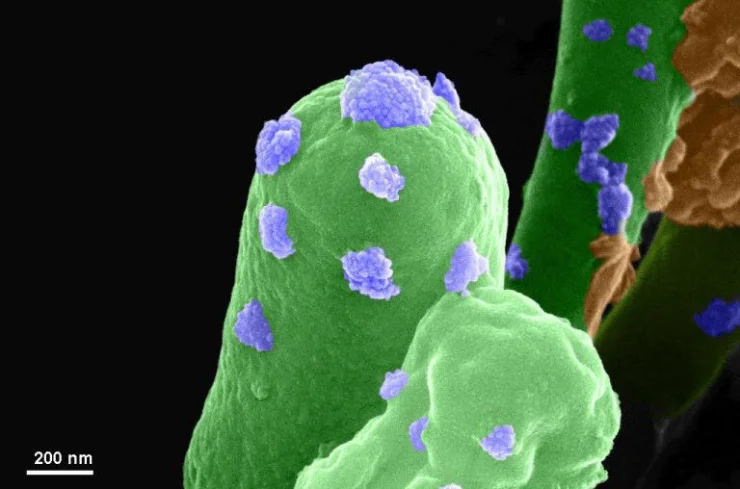
A chemical long considered toxic on Mars may turn out to be unexpectedly useful for building future habitats on the Red Planet. Researchers have discovered that perchlorate, a chlorine-based compound found naturally in Martian soil, could actually strengthen brick-like materials produced by bacteria, opening new possibilities for extraterrestrial construction.
In 2025, scientists at the Indian Institute of Science demonstrated how the soil bacterium Sporosarcina pasteurii could be used to manufacture building materials from lunar and Martian regolith. The bacterium produces urea as a waste product, which reacts with calcium to form calcium carbonate crystals. When these crystals are combined with guar gum—a natural adhesive derived from guar beans—the mixture binds particles of local regolith into a solid, brick-like substance. This approach supports in situ resource utilization, a strategy aimed at minimizing the need to transport heavy construction materials such as cement from Earth.
“As much as possible, the idea is to use resources available on-site,” said Shubhanshu Shukla, an Indian Space Research Organisation (ISRO) astronaut and co-author of the study. Producing structures locally, he explained, would make long-term missions easier and more sustainable.
Because authentic lunar and Martian regolith samples are rare or unavailable, researchers rely on simulants—artificial materials designed to closely mimic real soil. For safety reasons, these simulants usually omit perchlorate. Although perchlorate is toxic, the primary concern in laboratories is its flammability. On Mars, however, perchlorate is common, accounting for roughly 0.5% to 1% of the soil.
To address this gap, microbiologist Swati Dubey of the University of Florida and her colleagues carefully added perchlorate to a simulant known as Mars Global Simulant 1. They then studied how it affected Sporosarcina pasteurii. Using a hardy strain found near Bengaluru, India, the team observed predictable stress responses: slower growth, clumping of bacterial cells, and increased secretion of proteins and molecules that form an extracellular matrix (ECM).
What surprised the researchers was that, despite cellular stress, the resulting bricks were stronger than those produced in earlier experiments. Electron microscopy revealed increased formation of calcium carbonate crystals and tiny “microbridges” created by the ECM between bacterial cells and crystals. These microbridges appear to enhance bonding within the material.
“When studied alone, perchlorate is stressful for bacteria,” Dubey explained. “But within the brick mixture, it actually helps.” She suggests the ECM may aid nutrient transport, allowing bacteria to recover and improve biocementation.
Next, the team plans to test this hypothesis further and explore how the process performs in a carbon dioxide–rich atmosphere similar to Mars. As co-author Aloke Kumar noted, understanding how Earth organisms behave in alien environments is a critical scientific challenge for future space exploration.